A few months ago, we took on a catalog of 472,663 products. The titles looked like internal logistics codes. Thousands of missing attributes. No parent/child relationships between variants. And one simple goal: turn it into a working B2B Magento 2 site for hospitality professionals (cafes, hotels, restaurants). That’s where an AI co-pilot for e-commerce on Magento becomes indispensable.
No human team could process this manually. Not in 6 months, not in 12. This kind of challenge is what pushed us at Sutunam to build real AI enrichment pipelines, building on what we presented at Meet Magento France 2025. Not gimmicks. Production systems.
On June 25, 2026, I presented “My AI Co-Pilot” at Meet Magento France in Paris. This article covers the basis of that talk: what works, what failed, and how we connect AI to a real catalog.
The real problem: your teams execute instead of deciding
Talk to any e-commerce manager running more than 1,000 SKUs on Magento. Their daily reality looks like this: manual attribute entry, SEO content copy-pasted from one product to the next, visuals produced one by one, restocking decisions based on gut feeling. And publishing a batch of new products takes 3 to 5 days.
This isn’t a competence problem. It’s a volume problem. Teams spend most of their time on repetitive execution, and too little on strategic thinking. The ratio should be reversed.
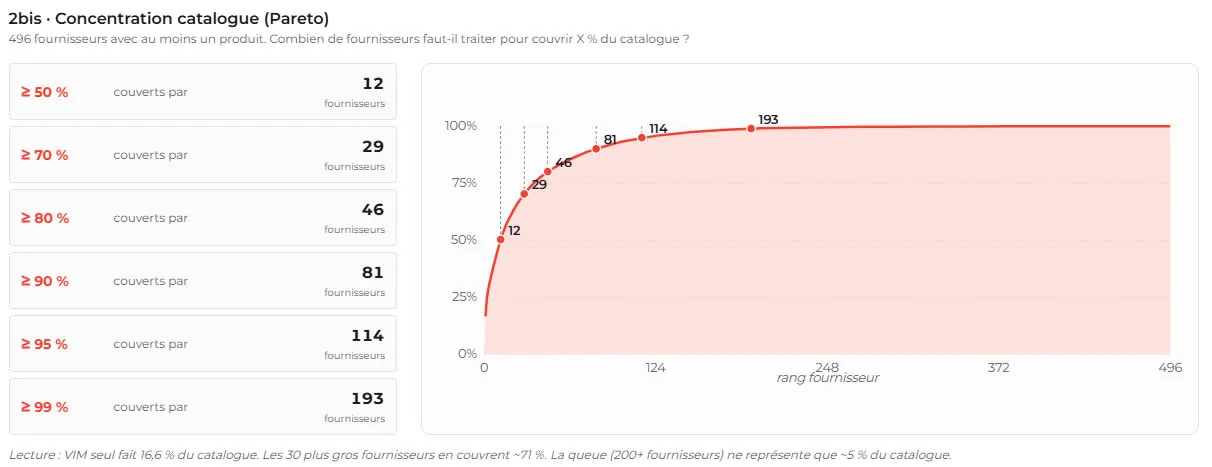
On the project I mentioned above, we’re talking about 496 suppliers. A Pareto analysis showed us that 12 of them covered 50% of the catalog, and 114 covered 95%. This kind of insight is exactly what AI surfaces in minutes, where manual analysis would have taken weeks.
What an AI co-pilot changes in a Magento e-commerce (and what we learned doing it)
Product sheet generation: 2,000 in 45 minutes, but not without guardrails
AI retrieves technical data from your PIM (Akeneo, Pimcore, Salsify, or any connector via ETL and APIs). It generates unique descriptions adapted to your brand voice, optimized for SEO, and enriches missing attributes.
On a recent project, we processed 2,000 product sheets in 45 minutes. The same work previously took 3 days for a team of 2 people.
But the real lesson wasn’t about speed. It’s that AI can’t do everything on its own.
On the 472,000-product catalog, our first approach was to let TF-IDF clustering automatically categorize products. The result: the “Stainless Steel Furniture” category was overestimated by 35%, “Cooking Equipment” underestimated by a factor of 3, “Hygiene” underestimated by a factor of 2.25. And an entire category, “Pastry,” wasn’t detected at all.
We went through 20 iterations before reaching a reliable classification. V1, based on an LLM (Claude Haiku), achieved 93 to 99% accuracy on 50% of the catalog. But it only worked because we had first manually defined the attribute architecture. This is a step many underestimate: AI enriches, but humans structure. Without that business framework, AI produces noise, not data.
SEO at catalog scale
Generic SEO descriptions hurt your rankings. Google rewards unique content, and a catalog of 5,000 products with near-identical descriptions gets penalized.
AI generates unique descriptions per product, tailored to your customers’ search intent. It produces relevant meta descriptions and identifies keyword opportunities your competitors are missing. All at a scale impossible to achieve manually.
Decision-making intelligence: the central topic of my talk
AI no longer just produces content. It analyzes your sales data, inventory levels, and customer behavior to suggest decisions in real time.
Which products to restock first? Which price to adjust based on demand? Which visuals convert best in which context? AI proposes, humans decide. That’s the shift from tool to AI co-pilot for e-commerce on Magento.
“AI hallucinates”: no, if you do the work upstream
This is the objection we hear most often. And it’s legitimate when AI is used as a raw text generator without controls.
At Sutunam, our job is precisely to make sure that doesn’t happen. How? By never asking AI to invent data. It enriches from verified sources: manufacturer technical sheets, PIM data, standardized product databases. We scrape supplier websites through automated pipelines (N8N), normalize the data in a human-defined structure (Pimcore), and AI fills the gaps based on that foundation.
On the 472,000-product catalog, EAN codes (barcodes) were present on the vast majority of items. We use them as scraping keys to fetch manufacturer data. AI doesn’t fabricate information: it finds it, structures it, and normalizes it.
That’s the difference between a chatbot that improvises and a reliable production system. It is also the message I took on stage at Meet Magento France 2026.
5 signs your e-commerce needs an AI co-pilot
How do you know if your Magento store needs an AI co-pilot for e-commerce?
Here are the indicators that come up most often with the merchants we work with:
- Your product sheets take longer to write than to sell. If your team spends 3 days publishing a batch of 50 SKUs, AI can reduce that to a few hours.
- Your restocking decisions are based on gut feeling. AI analyzes your sales, inventory, and trends to suggest the right calls in real time.
- Your SEO is generic across the entire catalog. AI generates unique descriptions per product, tailored to your customers’ search intent.
- Your visuals are expensive to produce. AI adapts your existing images to every context and sales channel.
- Your teams manage instead of deciding. AI frees up time on repetitive tasks so your teams can focus on strategy.
If you recognize your situation in 3 out of these 5 signs, it’s time to explore what AI can do for your e-commerce.
The technical stack: how we wire it all together
For technical readers, here’s the typical architecture we deploy:
AI connects to your PIM via ETL connectors and standard APIs. It integrates natively with the Magento 2 and Adobe Commerce ecosystem, including Hyva configurations. AI agents are orchestrated by N8N to perform specific tasks (supplier scraping, attribute enrichment, classification, content generation) with guardrails built into every step.
On the Gafik project, the full stack is Pimcore (PIM), N8N (orchestration), LLM (enrichment and classification), Magento 2 (e-commerce), and Odoo (ERP). Every component communicates via API. No overhaul of your existing systems is required.
The solutions work on both Magento Open Source and Adobe Commerce, Cloud or On-Premise.
What’s next: your AI co-pilot, on your catalog
Theory is fine. A demo on a real catalog is better.
At Meet Magento France 2026, at the Salons de l’Aveyron in Paris, we presented this approach on a real Magento catalog.
Missed the talk? We can run the same exercise on your data: a 45-minute AI diagnostic to find the 3 most profitable use cases for your Magento store.