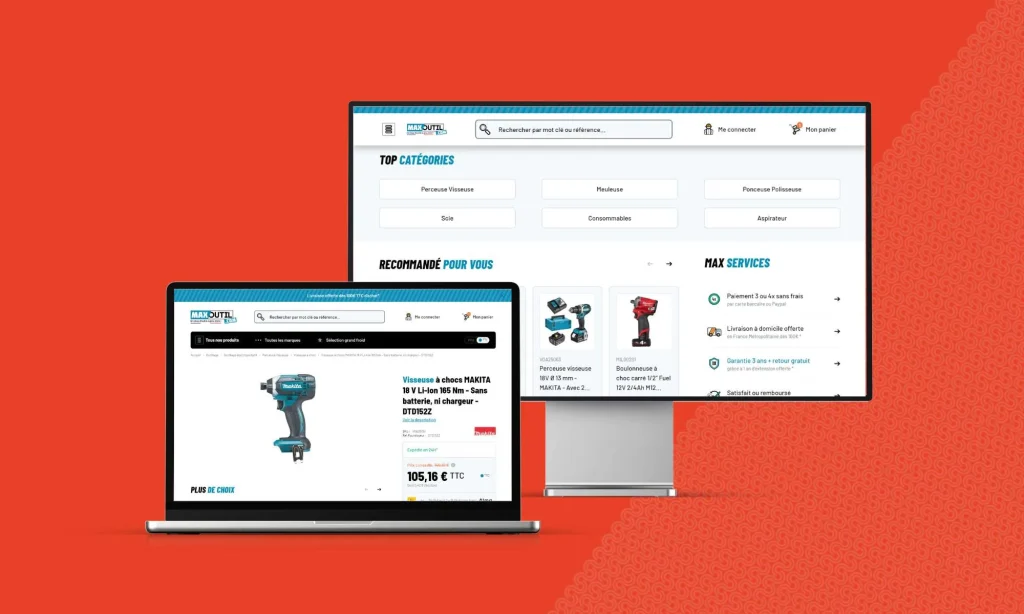
MaxOutil sells tools and equipment to trade and consumers on a Magento 2 store with a Hyvä front end. Some of its customers are not people but organisations: city halls, local authorities, companies with several sites. There, several people prepare the purchases and one person approves them. Magento Open Source cannot do this; we built it.
This article describes the need, what we built and who this way of working makes sense for. The whole project is told in the MaxOutil case study.
The need: several departments order, one approves
Take a city hall with several departments:
- the parks department needs a rake;
- the events department wants tables for a fair;
- accounting has to approve every purchase to keep to the budget.
Each department must be able to browse the catalogue, prepare a cart and submit it, without being able to pay. Accounting must be notified, review the cart, accept or reject it, and keep an overview of what is being bought.
This workflow exists in corporate procurement tools, and Adobe Commerce, the paid edition of Magento, offers company accounts with roles and order approval. Magento Open Source, which MaxOutil runs on, has nothing like it out of the box.
What we built
A customer account structure where:
- a parent account manages several child accounts;
- a child account has limited rights: it saves carts and lists, it does not place orders;
- when a child account submits a cart, the parent account is notified and can finalise the order or reject it;
- order history, carts and purchasing activity of all child accounts are visible from the parent account.
Everything is built inside Magento itself, with no external service: Magento’s access control lists (ACL) and customer groups, a module for cart status and the approval workflow, email notifications and approval screens in the customer account. The result is maintained like the rest of the store and can evolve with new business rules.
Who this way of working makes sense for
- city halls, local authorities and public bodies, where one department prepares the order and another commits the spend;
- corporate purchasing teams, with requesters and approvers;
- franchise networks and multi-site companies, where each site orders and head office keeps control.
And for your store?
If your customers buy as a team, with approvals, your Magento store can reflect it. We start by writing the rules with your sales and accounting teams, then build what Magento lacks. See our B2B offer on Magento or write to us.