There is a version of the future where every start-up generates its app screens with a prompt. The logo is on-brand. The buttons are in the right places. The prototype exists in minutes. And yet, something is missing.
We designed the UX/UI of the Yummix mobile app: a Thermomix recipe platform with more than 170,000 Instagram followers and over ten years of content, moving into a native app. The project taught us something we want to say out loud: AI is a powerful accelerator. It is not a replacement for expert design thinking.
The problem was never visual
Yummix did not need prettier screens. It needed a rethink of how a web platform built over more than ten years could work in a kitchen: one hand busy, a timer running, a recipe halfway through a step. That kind of UX challenge is not solved by generating mock-ups. It is solved by asking the right questions first.
Yummix, founded in 2013, offers premium recipes, cooking tips, video tutorials, batch cooking plans and advanced search filters. Its community already lived on mobile. What it lacked was a native app, free from the limits of the website on a phone.
Workshops before any screen
Before touching any design tool, we audited the existing website: its content, its subscription model and how readers had used it for more than ten years. Every later decision built on this analysis.
With the Yummix team, we then ran UX workshops to map real cooking habits on a phone and align them with the business model. Together we defined the user journeys: finding a recipe, saving favourites, building a shopping list, subscribing. Settling these journeys before any development removed most of the delivery risk.
This is the work AI cannot shortcut: understanding what a user wants in a physical context, aligning it with a business model, and turning it into an interaction without friction. A prompt does not know that the reader has flour on their fingers.
Speed without shortcuts
Design sprints validated the full user journey in 10 days, before a single line of code: an interactive prototype that covered every journey. That speed came from a tight process, not from cutting corners:
- high-fidelity wireframes to check usability before the final graphics;
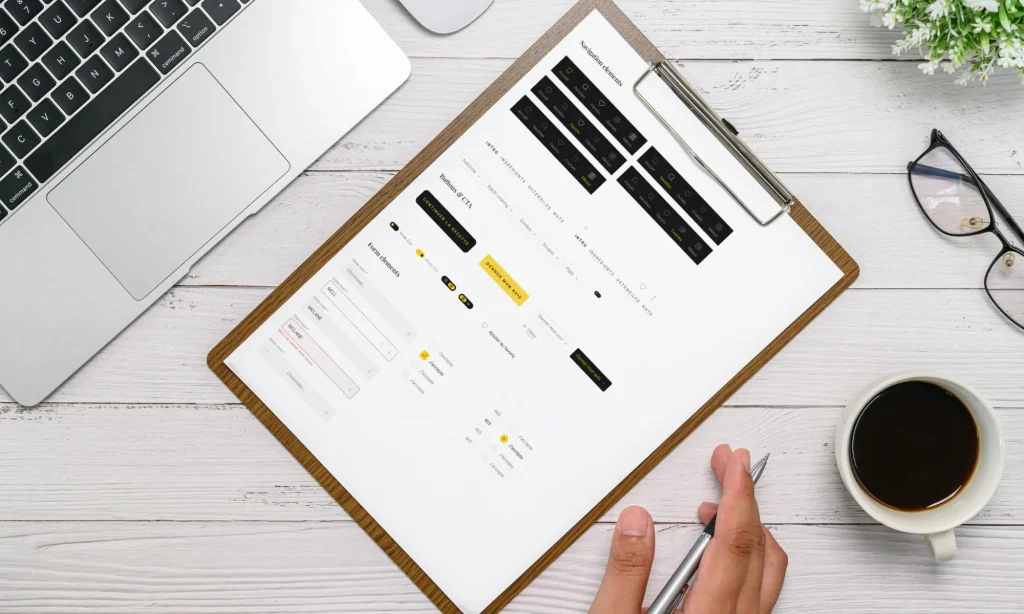
- a design system built with the atomic design method, from buttons to complete screens;
- complete documentation for every component and journey, ready for development;
- secure sign-in and subscription journeys, consistent with the existing website;
- the WCAG accessibility guidelines applied throughout.
The interactive prototype became the single reference for every team, and made the hand-over smooth with the mobile studio that developed the app in React Native (one code base for iOS and Android).
Constraints no tool reasons about together
The cross-platform challenge was real. The design system had to anticipate a React Native build, the Yummix Symfony APIs, and future Magento e-commerce and payment integrations. It also had to pass the App Store and Google Play guidelines with one design.
A generator can produce a screen that looks right. It does not check that the screen fits an API that already exists, a subscription model that pays the bills, and a store integration planned for later. A senior designer who understands the architecture does. That is the role our art director, Christophe, played on Yummix, from the first workshop to the hand-over.
AI helps. Expertise decides.
We use AI tools in our design process: for exploration, for iteration speed, for generating variations. They save time on the parts of the work that are about producing options.
But once a product has real users, a real business model and real technical constraints, someone has to hold all of it in their head and make a judgement call. Which variation fits a cook with one free hand? Which journey keeps a subscriber subscribed? Which component will still make sense when payments arrive? Those answers come from people who have run the workshops and know the constraints.
The Yummix app went live on the App Store and Google Play. In October 2026 it was rated 4.9/5 on the App Store (275 ratings) and on Google Play (114 reviews). That did not happen because the screens look good. It happened because the experience was designed with intent, from audit to atomic component, from workshop to hand-over.
“The team was attentive to our needs while proposing creative solutions. Their expertise and attention to detail allowed us to design a seamless user experience and a modern interface, aligned with our objectives.”
Rudy Baer, CEO of Yummix, in his Google review
What to ask an agency that “designs with AI”
Many agencies say they design with AI. That is not a problem in itself. Before you sign, ask:
- What happens before the first screen? An audit, workshops, user journeys? Or straight to mock-ups?
- Who makes the decisions? Is a named, senior designer responsible for the choices, or does the tool’s output go straight to you?
- What do the developers receive? A design system with documented components, or a set of pictures?
- How are technical constraints handled? Existing APIs, accessibility, store guidelines, future integrations.
- How is the design validated? On an interactive prototype, with the full journey, before development starts?
If the answers are clear, AI in the process is a plus. If the answer to all of them is “the AI does it”, keep looking.
Building a mobile product?
If you are planning a mobile product and wondering whether design still matters when AI can draw screens: it does. Read the full Yummix case study, see how our Design Studio in Hanoi and Lyon works, or explore our user experience services. To test an idea on a working tool first, see rapid prototyping with AI.