An online store never works alone. Stock lives in an ERP or in the shops’ tills. Product data lives in a PIM or in suppliers’ systems. Orders go out to an OMS, customer data to a CRM. Between all these systems you need a tool that extracts the data, reshapes it and loads it in the right place, at the right pace. That tool is an ETL (Extract, Transform, Load).
This article starts from three custom ETLs we built: for Bébé9, Car Lovers Occasions and Autobonplan. They are three separate tools, built for three different problems. We then look at where AI really fits in these flows, and at the questions to ask before you buy an “AI ETL”.
What an ETL does for an online store
The idea fits in three verbs:
- Extract the data from its source: an ERP API, a file dropped on an FTP server, a supplier feed, a till database.
- Transform it: align units and labels, remove duplicates, compute what is missing (a discounted price, a monthly payment, available stock), and decide which source wins when two systems disagree.
- Load the result into the destination (Magento, Sylius, a PIM, an ERP), with a log, retries when something fails and an alert when something is stuck.
The difference with a plain API integration is the second step. An integration passes the data on as it is, disagreements included. The ETL is where you decide which value is right, and where you find out that a rule was wrong before the error reaches the store.
Each type of data also has its own pace. Stock and prices must move within minutes, because a mistake means a sale you cannot fulfil. Accounting entries or reporting can wait a few hours. Setting this pace, data type by data type, is part of the design work.
Three ETLs, three problems
| Project | Sources | What the ETL does | Destination |
|---|---|---|---|
| Bébé9 | More than 100 stores, no central warehouse | Aggregates stock, prices, campaigns and media | Magento 2 and Hyvä, then OMS, ERP and CRM |
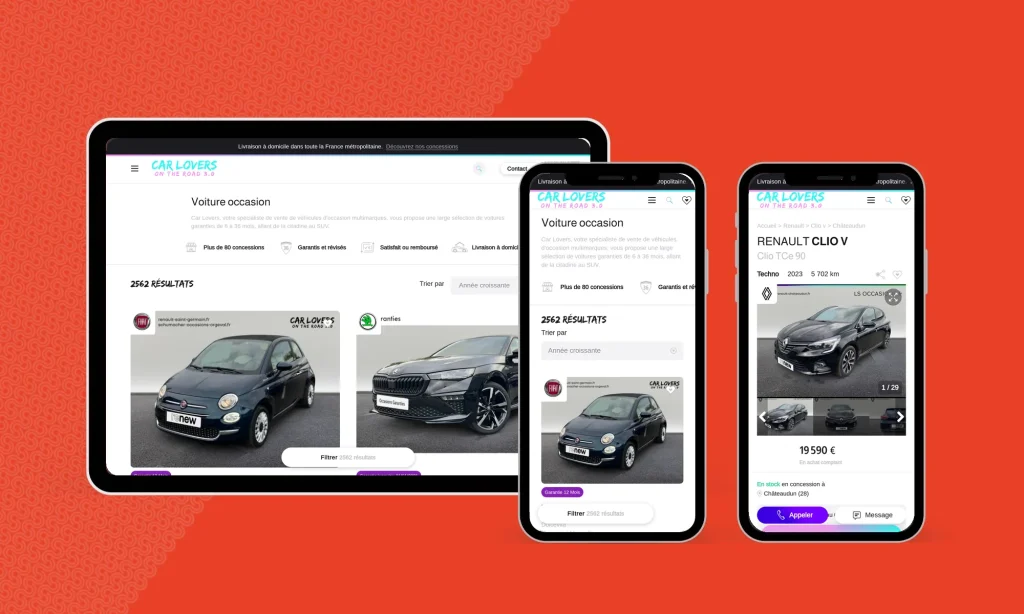
| Car Lovers Occasions | More than 80 dealerships, 22 brands | Imports, normalises, computes monthly payments | Sylius and Symfony |
| Autobonplan | Group tools and partner feeds | Feeds the vehicle catalogue and sends leads back | Magento, marketing tools and CRM |
Bébé9: more than 100 stores, no central warehouse
Bébé9 is a network of more than 100 baby-goods stores in France. It has no central warehouse: each web order ships from the nearest store (ship-from-store). Stock is spread over more than a hundred independent sources, yet the website must show one correct figure.
We first mapped how product, price and stock data moved through the network. We then built a dedicated ETL that aggregates this data and pushes it into Magento in near real time: stock per store, prices, promotional campaigns and media, with no manual entry. In the other direction, API integrations connect Magento to the retailer’s OMS, ERP and CRM for orders, shipments, invoices, credit notes, cancellations, returns and refunds. The details are in the Bébé9 case study.
The lesson goes beyond baby goods. A hundred sources with no natural point of consolidation is the same problem whether they are stores, depots or subsidiaries. The aggregation happens in the integration layer, and the business definition of “available” is agreed before the first record moves.
Car Lovers Occasions: more than 80 dealerships on one website
For the Car Lovers group (formerly LS Group), we built a used-car website from scratch in 2021, on Sylius and Symfony. It brings together the stock of more than 80 dealerships and 22 brands. At its core, a custom ETL imports the dealerships’ vehicles, normalises the data (makes, models, equipment, photos) and computes the monthly payment shown on each listing. In November 2026, it kept more than 2,500 vehicles up to date online.
Keeping the ETL separate from the rest of the site paid off in 2024-2025. When the group changed its financing partner, we reworked the import and the finance simulator without touching the rest of the store. See the Car Lovers Occasions case study.
Autobonplan: the catalogue of a large car dealer group
Autobonplan is the online store for new and used vehicles of the Jean Rouyer Automobiles group (JRA), the fifth largest car dealer group in France. From the launch, we connected the group’s tools (ERP, vehicle feeds) to the website to feed the available vehicles, and linked everything to the marketing tools and the CRM so that contact requests reach the sales team. This work led to a custom ETL built for the group, which receives stock through APIs and files and then sends it on to car listing websites. The Autobonplan case study tells the original project.
Car Lovers and Autobonplan both sell cars, but their ETLs share nothing except our team’s know-how. Sources, rules and destinations differ, and each client paid for its own development.
Where AI enters the data flows
A classic ETL applies rules written in advance. AI helps where rules are not enough: unreadable supplier labels, missing attributes, categories to guess across hundreds of thousands of rows. It can fix inconsistencies (units, formats, duplicates), suggest a match between two sources, complete a product record or translate it.
Our clearest example is a B2B catalogue of 472,663 products for a supplier to cafés, hotels and restaurants, described in our article on AI as the e-commerce manager’s co-pilot. Product titles looked like warehouse codes and thousands of attributes were missing. Three lessons matter for an ETL project:
- AI does not make up data. We used EAN barcodes as the key to fetch manufacturer data, then AI structured and normalised what it found.
- People structure first. The classification only became reliable after we defined the attribute architecture by hand, and after 20 iterations.
- Analysis comes with it. Out of 496 suppliers, 12 covered 50% of the catalogue and 114 covered 95%. That told us which feeds to handle first.
The other use is downstream: AI agents connected to the ERP that read orders, invoices and approval rules, answer with their sources and change nothing without human approval. They do not replace the ETL. They need synchronised, reliable data to give correct answers.
Before you buy an “AI ETL”: questions to ask
- Who owns the code and the mapping rules? If the tool disappears or you change provider, can you take over the pipeline?
- Which system is the master for each type of data? Stock, price, product, customer: write the answer down before the first flow, or the systems will overwrite each other.
- What happens when a source goes down? The store should keep serving the last valid data, failed batches should be retried, and someone should be alerted, for example when an order has not reached the ERP within a set delay.
- Where does AI step in, and who approves? AI that completes a record from verified sources carries a different risk from AI that invents an ingredient list or a technical feature.
- Where do the models run? On your servers, in your region or on a large model provider’s infrastructure: the choice depends on how sensitive your data is.
- How does the system handle peaks? A queue that smooths the load and priority flows (stock, order confirmations) protect the store during sales or Black Friday.
Regulated product data raises the same questions with one more constraint. For food products, we cover it in our article on the Alkemics / Salsify connector and the INCO rule.
Where to start
All our data flow projects start with a map: which data moves, from where, how often, and with which manual steps. The map shows whether a custom ETL is worth it, and where AI would bring a real gain. Our team works across Europe and Asia, in several time zones. To discuss your case, see our ETL and real-time data sync service.